

By Eunice Monserrat Jaimes
In this note, we are going to tackle the impact of the industrial pollution problem in China. Industrial pollution issue is an important problem for China and the entire world because of its implications in the economic, health, and environmental areas. It is true that China is one of the biggest countries in the world, also it is the country with the most inhabitants (CIA Factbook, 2019) and the second economy of the world.
In the current 21st century we all live in a world with several problems of contamination, an issue that mainly is caused by industrial production around the world. China is a country which has grown considerably in the last years. Thus, Chinese pollution is an industrial, commercial and economic development consequence that responds to the challenges of the globalization era; contamination is the negative result of the globalization.
Since the reform of Deng Xiaoping in 1978 for Chinese economic development, the economy is based in the use of natural resources in order to increase industrial profits, an issue that has caused important natural damages in China: contamination in rivers, in the air, desertification, human health problems, etcetera.
China’s economic growth and the damage of the industrial pollution
Asia is a region that was hidden in the dark for a lot of years, however, in the 21st Century Asia has become in an economic giant, a matter that has changed all the dynamic of the world; nowadays there are new forms of relationships, new forms of communication and technology (Oropeza, 2017). The United States is not anymore the big power, China has become through the years the second economy in the world (Paulo, 2013).
In 1978 Deng Xiaoping made a reform with the aim of modernizing China, the country’s economy has been based on industrial production (Oropeza 2014); China started producing goods at a low cost (Oropeza, 2017), like Amsden Alice (2004) said “the rest succeed in building mid technology industries, and now it has achieved its own knowledge-based economy”. China has experienced an average annual economic growth of 9 percent thanks to the industrial sector, that has contributed 40.5 percent to the GDP (World Bank, 2017).
The Chinese industrial pollution is a result of the economic growth through history mostly in the last century because of the capitalism in its globalizing era (Hernández, 2004), it has become a strong economic power within the international stage. Chinese industrialization has provoked some shifts in the society; for example, the big urbanization, the faster population growth. These changes have caused severe ecological damage, mainly in water and air pollution, land desertification, environmental disasters, floods, among others (Cook, 2006) .

Chinese industry is characterized by high consumption of natural resources and energy; before the 1920s, the main cause of air pollution in high-income industries was the rapid spread of coal-fired industry during the second phase of the Industrial Revolution (Han et al, 2017). Heavy coal has become the main source of energy, but it produces big emissions of sulfur dioxide and dust. According to the World Health Organization, 500 of the biggest cities do not have enough air standards, that matter causes illness in the people because of the acid rain (Paulo, 2013).
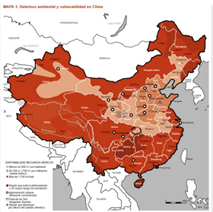
Another big problem is the industrial discharges of toxic substances into rivers and lakes. In 1994 the Chinese government started a tax collection reform that reduced local government incomes, this generates that the localities created their own industrial projects so many small companies born in China. This matter caused a local economic growth, however, there were great damages to the environment due to the omissión of the application of the environmental laws (Paulo, 2013).
Nowadays, China’s water availability per capita is already only a quarter of the world average with 200 cubic meters; the 70 percent of lakes and rivers are contaminated and 420 Chinese cities have water crisis; only the 70 percent of the water is treated (Cook, 2006). Also there have been many toxic spills like the one in Songhua River, in Guangdong at the Perla River and the Longjiang River case.
How has China reacted to industrial pollution?
There is a dichotomy between economic growth and care for the environment, it is hard to take measures to generate a balance: economic growth and the least impact on the environment. China has already done many legal frameworks in order to regulate the economic forces and the necessity to protect the environment and halt the accelerated advance of climate change, but the most of those measures are left only in the speech.
The creation of new frameworks for environment protection was born in many Chinese people objection. The first legal documents about the natural resources care were the Environmental Protection Law in 1979; after that fact, the legal framework has increased with the aim of setting up the regulation of chemical substances, growing planning, gas emissions of the industries, and so on (Cook, 2016). China has created national Commissions, Internacional Treatments for the environment protection, laws, etcetera because of the concern about the climate changing (Paulo, 2013).
Nevertheless, the 12th Quinquennial Plan is the legal document most important, because it is the first Quinquennial Plan (2012-2015) that introduce inside its objectives the protection of natural resources, sustainable growth, and reduction of social disparities (Paulo, 2013). However, China is not a member of Annex 1 of the United Nations Framework Convention on Climate Change, that is China does not accept the compromises of the Kyoto Protocol
(Hernandez, 2004).
Conclusions
China is the fifth largest country in the world with 9, 596, 960 square kilometers and according to the CIA Factbook, China is the more populated country in the earth with 1, 384, 688, 986 people, the matter that directly impacts in the global pollution generation and the climate change damage. China is a country that population increases approximately 10 millions of people per year, that is why it is important for international society, we all live in the same world. Thus it is important to create public politic in order to control the water use in the manufacturing and agricultural industry, and it is not a China problem, contamination is a problem of all the countries in the world.
References
- Amsden, A. (2004). “The rise of the Rest Challenges to the West from late-industrializating industries”. Oxford University Press.
- Cook, I. (2006). “El medio ambiente en China”, Anuario Asia Pacífico.
- Han, L et al. (2017). “Multicontaminant air pollution in Chinese cities” Bull World Health Organ.
- Hernández, R. (2004). “La contaminación en China” México y la Cuenca del Pacífico, Vol 7, núm 237, México, septiembre-diciembre.
- Borthwick, M. (1988). “Pacific century. The emergence of Modern Pacific Asia. Westview Press, USA, Second Edition.
- Oropeza, A. (2014). “China y su modelo de desarrollo: las líneas generales desde la perspectiva de México”, Instituto de Investigaciones Jurídicas de la UNAM.
- Oropeza, A. (2017). “From the Atlantic to the Pacific: the new global order”, Universidad Nacional Autónoma de México, Instituto de Investigaciones Jurídicas.
- Paulo, M. (2013). “El medio ambiente en la República Popular China: ¿existe espacio para las organizaciones medioambientales?”, Simposio electrónico internacional sobre política china, Universidad de Pekín.
- World Bank. (2017). Industria, valor agregado (%PIB). Recover https://datos.bancomundial.org/indicador/NV.IND.TOTL.ZS4
 Hic et Nunc